

















































































































































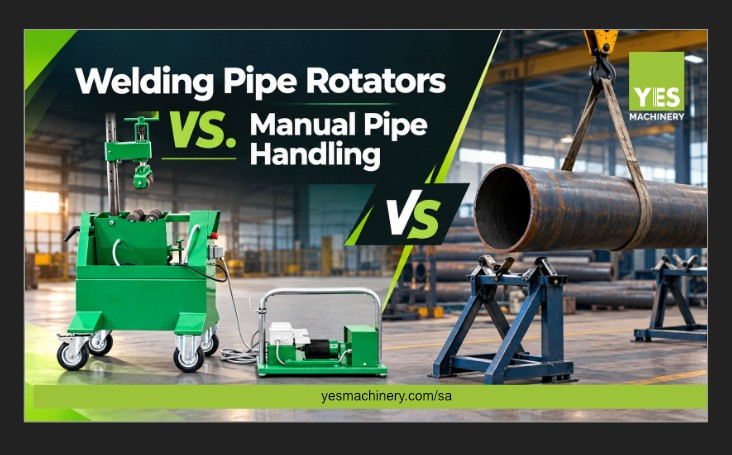
Welding Pipe Rotators vs. Manual Pipe Handling
- Category Machines
Welding long pipes calls for constant accuracy and consistent movement to form sturdy and trustworthy joint seams. Conventional manual movement entails hard work and often results in uneven travel speeds in manufacturing processes. Motorized pipe rotating rolls represent an efficient alternative that provides smooth rotation, increased safety, and enhanced productivity in fabrications shops.
What Is Welding Pipe Rotators vs. Manual Pipe Handling?
In the current blog, motorized turning rolls will be compared with traditional physical moving techniques that are employed in pipe fabrication shops. Such comparison will help fabrication managers make a choice between two core shop approaches to enhance their manufacturing processes and increase efficiency.
1. Motorized Turning Rolls
A motorized welder's rotator rotates a cylindrical part of material under a fixed welding torch through use of motorized wheels. Consistent rotation enables a worker to perform work at optimum angles and travel speed.
2. Manual Manipulation Technique
Workers have to turn and move pipes manually by hand or with the help of simple pry bars. Manual operation usually interrupts the welding arc and creates uneven beads because of uneven speed of rotation.
3. The Main Operational Difference
The principal difference revolves around equipment cost versus hard labor and cycle speed.
Uses, Benefits, and Key Advantages
1. Uniform Weld Qualities In All Joints
The use of motorized pipe rotators provides uniform speeds that guarantee a seamless deposition of molten metal all round the cylinder. Manual handling results in inconsistent speeds since the operators have to continuously stop the welding procedure to manually move the weighty pipes forward through pushing.
2. Lessening of Heavy Manual Strain
Bending, lifting, and levering of the weighty steel parts during the process of manual welding of cylinders is physically tiring for workers. The automatic rotation handles all the hard turning operations silently. Workers remain comfortably positioned in ideal work postures. Minimizing physical strain reduces fatigue for welders. This allows them to be productive through their work shifts.
3. Increased Output In Pipe Manufacturing Plants
An automatic pipe rotator ensures constant mechanical rotation. Hence, the process is not interrupted by pauses that result from the manual movement of steel parts to new positions. Welding is done continuously in one pass without any need to lay down the welding torch and make adjustments on support stands.
4. Improved Workplace Safety and Decreased Risk of Injury
Turning heavy pipe spools manually is highly dangerous and entails risks of smashed fingers, foot injuries, and extensive tearing of muscles. Powered turning beds fix the workpiece securely between two heavy rollers made of either polyurethane or steel to avoid any accidental displacement or falling off. Establishing a solid base reduces accidents and protects the manufacturing plant from expensive injury down time.
5. Precise Alignment for Automated Welding Equipment
For automated welding equipment to make perfect weld joints, there should be consistent movement of the workpiece under the arc. Manually moving the workpiece does not provide adequate coordination of speed necessary for submerged arc or mechanical orbital welding torches. The powered turning rolls combine well with the welding control equipment for consistent results in every weld.
6. Increased Versatility in Handling Diverse Sizes of Pipes
The adjustable frames of the turning rolls can handle different sizes of pipes by varying the distance between the centers of the rolls. Moving manually handled pipe spools becomes difficult when changing from thin tubing to large heavy process lines.
7. Less Labor and Operational Costs Over Time
Manual rotation of pipes usually involves a number of assistants who can only help with rolling, stabilizing, and holding the heavy metal parts to enable the pipe turner to concentrate on welding. The automated pipe rotating machine enables a skilled welder to rotate the metal while controlling the speed and arc at once. The movement of support staff to different shop activities results in lower number of employee hours spent per each project.
8. No Grinding and Re-welding
The manual pipe rotation process produces inconsistent bead starts, stoppages, and appearance that results in substantial amounts of grinding work. Consistent automated rotation produces consistent weld beads that pass ultrasonic tests with ease. The absence of grinding of welds helps to retain wall thickness and save a lot of labor time.
9. Controlled Heat Input Rate
Uniform rotation speeds help welders to control the heat input rate into the metal around the joint per each pass. The manual rotation process involves local overheating due to the stoppages which cause burn-through and warping of metal. The powered rotors help distribute heat evenly along the joint seam.
10. Accurate Positioning of Workpieces for Huge Operations
Pipe spools and pressure vessels are extremely dangerous and hard to handle by mere hand tools alone. Rotator beds provide safe handling of very heavy weights. This helps in giving stable performance even when dealing with huge and unbalanced pipe branches. This ensures that welders can comfortably rely on the machine and be able to concentrate only on puddling.
Conclusion
By preferring motorized welding pipe rotators to manual manipulation, welding shops will experience improved safety and productivity. Manual manipulation may work for minor and occasional jobs. However, it will never compare with mechanical operation regarding consistency and physical comfort. Purchasing the right brand rotors from reputable businesses like YES Machinery and the right usage will help protect your workers from injuries while ensuring good welds for your clients.
Related Blogs
Search
Latest Blog
How Part Inspection Machines Help in Reducing Manufacturing Defects?
Benefits of Using Scissor Lifting Tables in Industrial Operations
Importance of Plate Rolling Machines in Modern Metal Fabrication
Categories
- Assembly and Lean
- Cleaning Machines
- Cleaning Robots
- Cutting, Notching, Punching
- Edge Preperation
- Grinding Machines
- Industrial Vacuum Cleaners
- Lifting
- Lifting and Manipulation
- Machines
- Marking Solutions
- Metal Forming
- Metal Joining and Fastening
- Packing
- Parts & Consumables
- Pipe Handling
- Storage Solutions
- Sweeper Tool Carrier
- Vacuum lifting machine
- Warehousing and Storage
- Welding