






















































































































































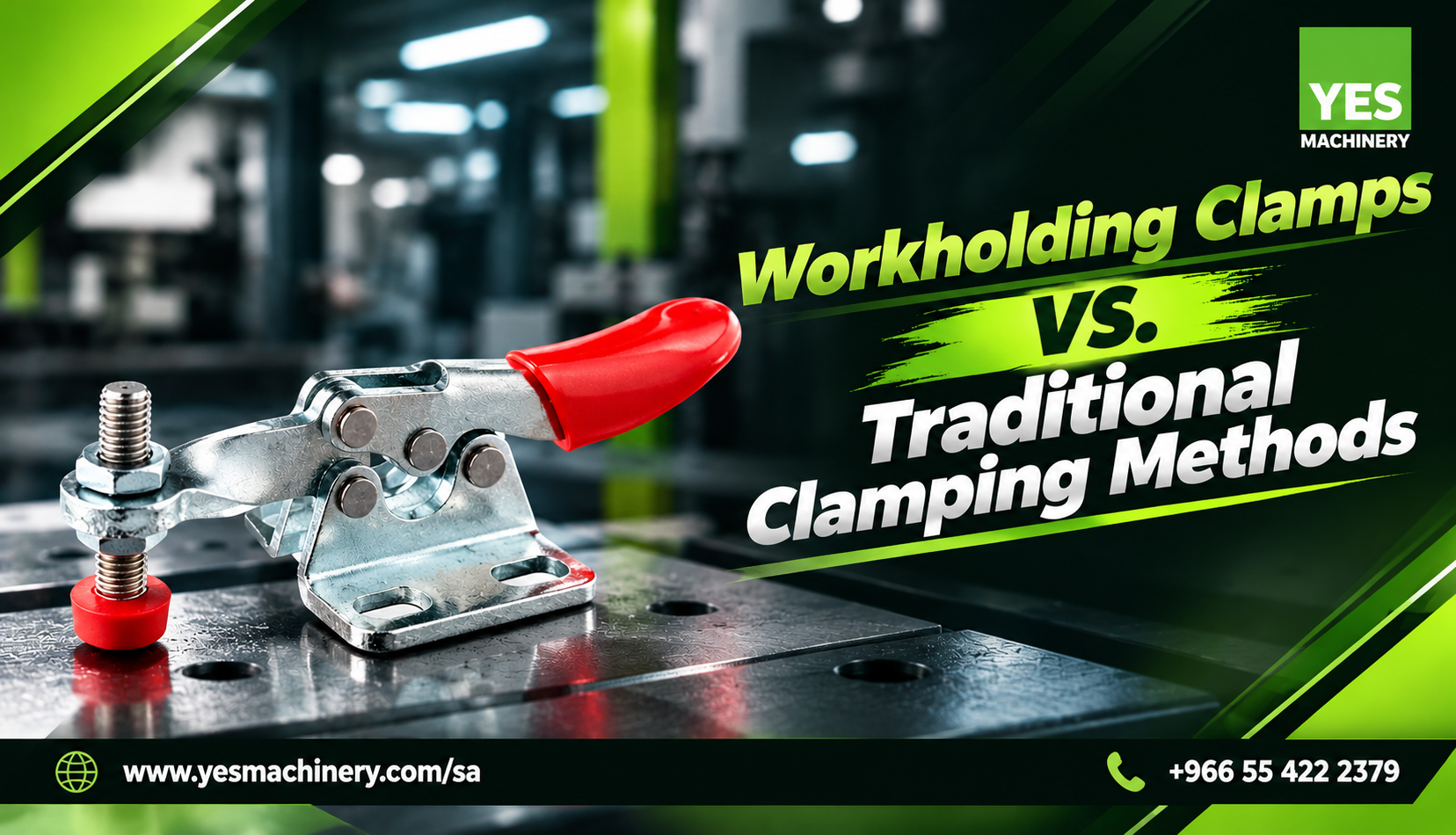
Workholding Clamps vs. Traditional Clamping Methods
- Category Machines
Parts go through a variety of operations in industrial applications. But before they get cut, drilled, or welded, they need to be properly held in place—this is what the workholding clamp enables. And the difference in the quality of the work is often much different while using both newer and older workholding mechanisms.
What Are Workholding Clamps?
Workholding clamps are used to hold a work item steady while it's being machined. Modern options include heavy-duty toggle clamps, hold-down clamps, latch clamps, and pneumatic and hydraulic clamping systems, each built to deliver rapid clamping and secure holding without compromising the workpiece.
With these devices, you can get rid of unwarranted movement and vibration, resulting in a smoother and more productive workflow.
What Are Traditional Clamping Methods?
Traditional clamping generally includes basic vises or bolted-down fixtures to hold a workpiece steady. It uses simpler manual tools. They get the job done but also take a lot of time and manual effort and suffer from less flexibility compared to the modern clamping systems.
Workholding Clamps vs. Traditional Clamping: Comparison Table
| Feature | Workholding Clamps | Traditional Clamping Methods |
| Clamping Speed | Speedy clamping | Slower and requires manual effort |
| Holding Force | Secure and consistent holding force | varies depending on manual tightening |
| Versatility | Versatile across various sizes and configurations | Often rigid and limited to specific shapes or sizes |
| Workpiece Access | Easy accessibility | Depends entirely on the setup |
| Precision | Allows precision clamping through eliminating unwanted movement | Prone to shifting or vibration |
| Setup Time | Faster changeovers, shorter setup times | Takes longer to set up and adjust |
| Automation Options | Available in manual, pneumatic, hydraulic, and electric options | Mostly manual only |
Why Workholding Clamps Are Better
- Improved Workpiece Positioning
Workholding clamps are meant to deliver secure, precise holding to keep the workpiece in one place throughout the machining process. This eliminates the chance of shifting or misalignment that could happen with older clamping methods.
- Reduced Setup Time
It takes less time to set up because of its features, such as rapid clamping and quick release. It shortens changeover time between jobs. With the traditional method, there will be more manual adjustment, and it will cause time loss during the workflow.
- Enhanced Operator Safety
The clamping allows the elimination of any risk of workpiece shifting unexpectedly during machining. This results in avoiding any potential hazards for the operator. Some models, such as the electric gripper, add another layer of safety by adding a feature that prevents accidental openings, making the safety two-fold and reliable.
- Consistent Machining Results
Since they are built to avoid any unwanted shifts or movements, this helps the worker achieve more accurate and repeatable results individually across each part. But the traditional clamping heavily depends on manual tightening, which maintains inconsistencies in pieces throughout the machining process.
- Where Workholding Clamps Are Used
They are an integral part of a wide variety of applications, such as fixing, testing, welding, and assembly work across industries like automotive and food processing.
They are available in manual toggle clamps for advanced pneumatic and hydraulic systems, and choosing the right one for your operations depends on size, the nature of the job, etc.
Workholding clamps are used across a wide range of applications, including fixturing, testing, welding, and assembly work, spanning industries like automotive and food processing. Options range from manual toggle clamps to advanced pneumatic and hydraulic systems, giving businesses the flexibility to choose the right clamping method depending on the specific job, material, and production volume at hand.
Final Thoughts
Traditional clamping methods get the job done—absolutely. But the modern ones do it infinitely better and profitably from an operational standpoint. They allow faster setup, better precision, better holding force, and safer operation. Manufacturing industries rely on accuracy, efficiency, and repeatability. Here, workholding clamps prove to be more capable than the traditional clamping methods.
If your business in Saudi requires modern clamping solutions, YES Machinery is your go-to place for the best equipment from specialists around the globe. Connect with us to explore our product range and choose the one that suits your operations best.
Related Blogs
Search
Latest Blog
How Industrial Workbenches Improve Productivity in Metal Fabrication Workshops
How Metal Tipping Containers Make Industrial Waste Handling Easier
Workholding Clamps vs. Traditional Clamping Methods
Categories
- Assembly and Lean
- Cleaning Machines
- Cleaning Robots
- Cutting, Notching, Punching
- Edge Preperation
- Grinding Machines
- Industrial Vacuum Cleaners
- Lifting
- Lifting and Manipulation
- Machines
- Marking Solutions
- Metal Forming
- Metal Joining and Fastening
- Packing
- Parts & Consumables
- Pipe Handling
- Storage Solutions
- Sweeper Tool Carrier
- Vacuum lifting machine
- Warehousing and Storage
- Welding